

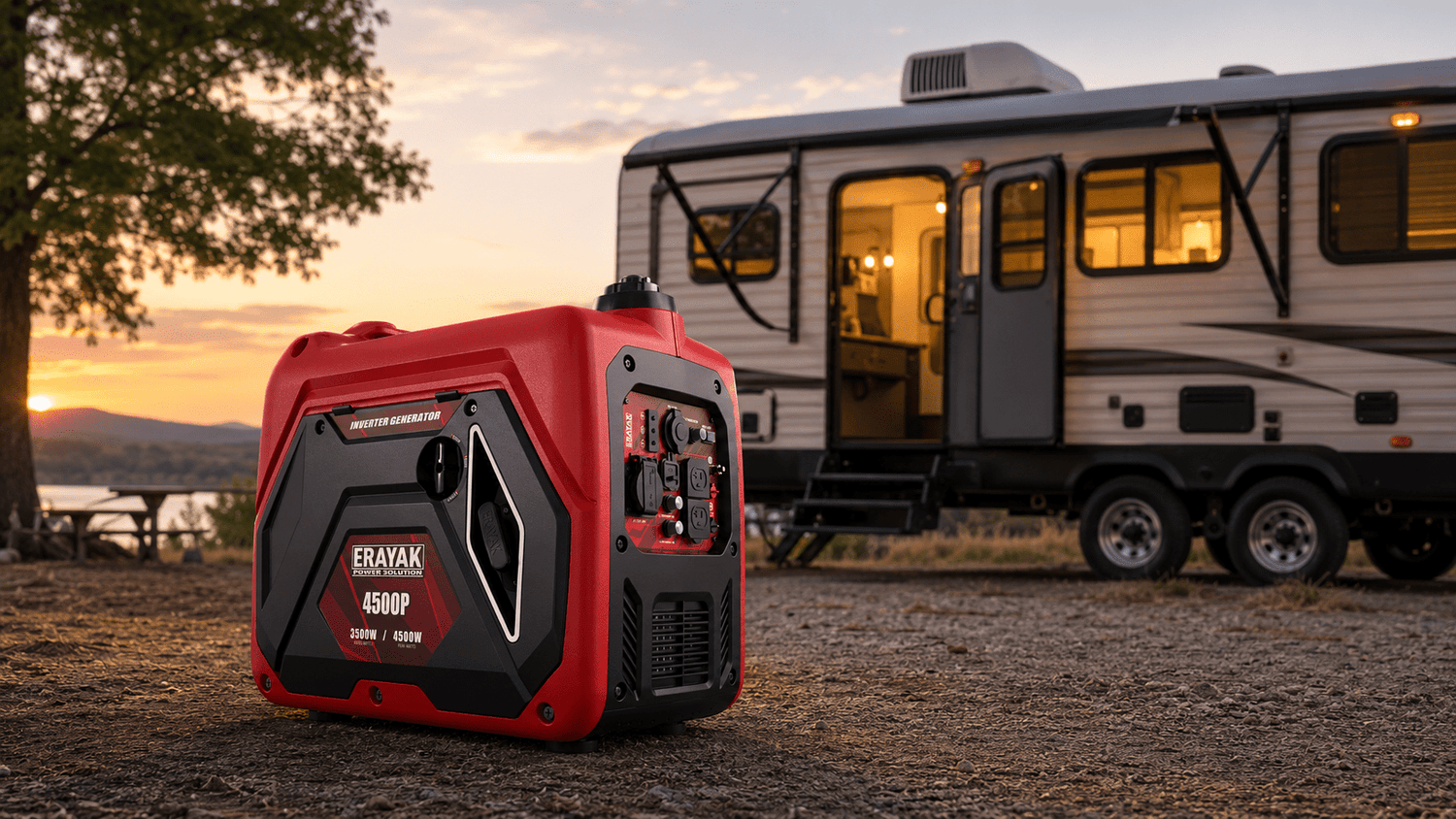
RV AC Generator Sizing
What Size Generator for 30 Amp RV AC? 13,500 & 15,000 BTU Chart
For a 30 amp RV with one rooftop air conditioner, a 4,500W-class inverter generator is usually the practical choice. A 13,500 BTU RV AC often needs about 1,300-1,600 running watts and 2,500-3,000 starting watts. A 15,000 BTU RV AC often needs about 1,500-1,800 running watts and 3,300-3,800 starting watts.
A 2,500W generator is usually not enough for a standard rooftop RV AC unless a compatible soft start is installed, the weather is moderate, and other large RV loads are turned off.
Quick Answer
Quick Answer: 30 Amp RV AC Generator Size
For a 30 amp RV air conditioner, plan on a 3,500W to 4,500W inverter generator for many 13,500 BTU setups and a 4,500W-class inverter generator for most 15,000 BTU setups. The exact answer depends on AC starting watts, soft start, temperature, altitude, and what else is running in the RV.
For real RV use, do not size the generator only for the AC. Add the converter/charger, refrigerator controls, lights, TV, microwave, and other loads. That is why a 4500W gas inverter generator or a 4500W dual-fuel inverter generator is often a more realistic match than a smaller 2,500W unit.
RV AC Wattage Chart: Camper AC Running Watts vs Starting Watts
Most camper AC wattage questions come down to two numbers. Running watts are the watts needed after the compressor is already operating. Starting watts, also called surge watts, are the short burst required when the compressor starts.
If your generator cannot handle the starting surge, the RV AC may trip the generator overload protection even if the running watts look acceptable on paper.
| RV AC Size | Estimated Running Watts | Estimated Starting Watts | Practical Generator Size |
|---|---|---|---|
| 11,000 BTU RV AC | 900-1,200W | 1,500-2,000W | 3,000W inverter generator for light RV loads |
| 13,500 BTU RV AC | 1,300-1,600W | 2,500-3,000W | 3,500W minimum range; 4,500W-class recommended for margin |
| 15,000 BTU RV AC | 1,500-1,800W | 3,300-3,800W | 4,500W-class inverter generator for practical RV use |
| Dual RV AC setup | Varies widely | Very high combined surge | Requires careful load management and a higher-capacity RV power plan |
Important: Actual RV AC wattage varies by model, compressor design, thermostat setting, outside temperature, altitude, shore-power wiring, and whether a soft start is installed. Always check your RV AC label and owner manual.
How Many Watts Does a Camper AC Use?
A camper AC commonly uses about 900 to 1,800 running watts, depending on BTU size. Smaller 11,000 BTU RV AC units may run around 900-1,200W, 13,500 BTU units often run around 1,300-1,600W, and 15,000 BTU units often run around 1,500-1,800W.
The harder number is startup surge. A 13,500 BTU RV AC may need about 2,500-3,000 starting watts, while a 15,000 BTU RV AC may need about 3,300-3,800 starting watts. That is why a generator that looks large enough for running watts may still trip when the compressor starts.
What Size Generator for a 13,500 BTU RV Air Conditioner?
For a standard 13,500 BTU RV AC, plan around 1,300 to 1,600 running watts and 2,500 to 3,000 starting watts. A 3,000W generator may look close on paper, but it can struggle when the AC compressor starts in hot weather or when your RV converter, refrigerator controls, lights, or other devices are already drawing power.
Minimum Planning Range
A 3,500W inverter generator is a more realistic starting point than a 2,500W unit for many 13.5k RV AC setups.
Better Real-World Margin
A 4,500W-class inverter generator gives extra headroom for compressor surge and small RV background loads.
Best ERAYAK Match
Compare the ERAYAK 4500P gas inverter generator or the ERAYAK 4500PD dual-fuel series.
What Size Generator for a 15,000 BTU RV Air Conditioner?
A 15,000 BTU RV AC usually needs more starting surge than a 13.5k unit. Plan around 1,500 to 1,800 running watts and 3,300 to 3,800 starting watts. This is why a 4,500W-class inverter generator is usually the practical recommendation.
For 15k RV AC use, avoid running the microwave, electric water heater, hair dryer, coffee maker, or space heater at the same time the AC compressor is starting. These heating appliances draw heavy running watts and can overload even a larger portable generator.
Hot Weather and High Altitude Matter
High outdoor temperature can make the compressor harder to start. Higher altitude can also reduce engine output. If you camp in desert heat, mountain areas, or summer RV parks with heavy AC demand, choose extra generator headroom instead of sizing right at the limit.
30 Amp RV Air Conditioner Generator Size
Most single-air-conditioner travel trailers and campers use a 30 amp RV connection, but that does not mean the RV can use unlimited generator power. A 30 amp, 120V RV service can draw up to about 3,600 watts from shore power, while the generator still needs enough surge capacity to start the AC compressor.
30 Amp RV Answer
What Size Generator for a 30 Amp RV Air Conditioner?
For a 30 amp RV with one rooftop air conditioner, a 4,500W-class inverter generator is usually the practical choice. A 13,500 BTU RV AC may start with less in ideal conditions, but a 4,500W-class generator gives better margin for compressor surge, converter/charger load, refrigerator controls, lights, and normal campsite use.
| RV Setup | Common AC Load | Practical Generator Direction |
|---|---|---|
| Pop-up camper or small trailer | Small AC or occasional cooling load | Start with the AC label; many users need less than full-size travel trailers. |
| 30 amp travel trailer with 13.5k BTU AC | One rooftop AC plus converter and small loads | 3,500W minimum planning range; 4,500W-class gives better margin. |
| 30 amp RV with 15k BTU AC | Larger rooftop AC with higher surge | 4,500W-class inverter generator is the safer recommendation. |
| 50 amp RV or dual AC layout | Multiple high-load circuits | Requires careful load management and a larger RV power plan. |
This section is important because many searches mix RV AC size, 30 amp RV generator size, and camper generator sizing. For a single rooftop AC, starting watts usually matter more than the plug name alone.
High-Intent Question
Will a 2500 Watt Generator Run an RV Air Conditioner?
For a standard 13,500 BTU or 15,000 BTU RV air conditioner, the answer is usually no. A 2,500W generator may not provide enough starting watts for the compressor, especially in hot weather or when other RV loads are connected.
The exception is a carefully managed setup: a compatible soft start, minimal other loads, moderate weather, and confirmed AC starting watts within the generator's peak rating. Even then, a 2,500W generator should be treated as an edge case, not the default recommendation for RV rooftop AC.
A smaller inverter generator may be useful for lights, routers, charging, fans, and small campsite loads. It should not be treated as the default answer for RV rooftop AC unless your AC has a soft start, your loads are minimal, and your equipment ratings confirm it.
Can a Soft Start Let a Smaller Generator Run an RV AC?
A soft start device can reduce the initial compressor surge of many RV air conditioners. That may make some 13,500 BTU RV AC setups easier to start with a smaller generator. However, soft start is not a universal guarantee.
What Soft Start Can Help With
- Lowering compressor startup surge
- Reducing overload trips during AC startup
- Helping some RV AC units start on smaller generators
What Soft Start Cannot Guarantee
- Running every 13.5k or 15k BTU RV AC on a 2,500W generator
- Running microwave, coffee maker, or electric heater at the same time
- Overcoming every heat, altitude, wiring, or appliance condition
Install soft start equipment according to the manufacturer instructions or work with a qualified RV technician. If you do not have soft start installed, a 4,500W-class inverter generator is the more realistic path for many RV AC users.
Can You Run RV AC and Other Appliances at the Same Time?
Running the RV AC is only one part of the load. Your RV converter/charger, refrigerator controls, battery charging, lights, water pump, TV, microwave, and small kitchen appliances can all add watts. The issue is not only total running watts, but also when compressor and appliance surges happen.
| RV Load Combination | Practical Answer | Generator Planning Note |
|---|---|---|
| 13.5k RV AC + lights + phone charging | Often possible with a 4,500W-class inverter generator | Check starting watts and keep other large loads off during compressor startup. |
| 15k RV AC + converter/charger + refrigerator controls | Often possible with careful load management | Use extra headroom and avoid starting multiple compressor loads together. |
| RV AC + microwave | Maybe, but not ideal during compressor startup | Turn the microwave off while the AC compressor starts, especially in hot weather. |
| RV AC + electric heater or hair dryer | Usually not recommended | Heating appliances draw heavy running watts and can overload the generator. |
Best ERAYAK Generator Match for RV AC
Choose your generator by RV AC size, starting watts, fuel preference, and how many other loads you want to run. The right match is not always the smallest generator. It is the quietest inverter generator that still gives enough surge margin for your RV air conditioner.

Small Load / Soft Start Only
ERAYAK 2400P
Best for camping, charging, lights, routers, fans, and very light RV loads. Only consider it for RV AC when a compatible soft start is installed and your actual starting watts are within rating.

Gas-Only 4500W Option
ERAYAK 4500P Gas Inverter Generator
The ERAYAK 4500P is the gas-only option for RV users who want a 4500W-class inverter generator with manual recoil start, 55 lb weight, 2.25 gal fuel tank, up to 8 hours runtime, and THD < 1.2% clean power.

Best RV AC Match
ERAYAK 4500PD Dual-Fuel Series
The 4500PD series is the strongest fit for many 13.5k and 15k BTU RV AC users who want gasoline and propane flexibility for RV weekends, campground power, and outage preparation.

High-Capacity Upgrade
ERAYAK 6800PD / 6800PT Series
Choose the 6800PD/PT series when RV AC is only one part of a larger power plan, such as additional RV loads, selected home backup circuits, or 120V/240V backup planning. 6800PD is dual fuel; 6800PT is tri-fuel.
Generator Safety Notice for RV AC Use
Running an RV air conditioner from a portable generator must be done safely. Quiet, inverter, dual-fuel, and tri-fuel generators are still fuel-powered engines that can produce deadly carbon monoxide.
- Never run a generator indoors.
- Never run a generator in a garage.
- Never run a generator near open windows, RV doors, vents, or enclosed patios.
- Always operate generators outdoors with proper ventilation.
- Use properly rated outdoor cords and RV connection equipment.
- For home or selected-circuit backup, use approved equipment and consult a licensed electrician.
FAQs: Generator Size for RV Air Conditioners
What size generator for a 30 amp RV air conditioner?
For a 30 amp RV with one rooftop air conditioner, a 4,500W-class inverter generator is usually the practical choice. It gives better starting-surge margin for a 13,500 or 15,000 BTU RV AC plus small RV background loads.
Will a 2500 watt generator run an RV air conditioner?
Usually no for a standard 13,500 or 15,000 BTU RV AC without a soft start. Some soft-start-equipped 13.5k BTU setups may work with light loads, but a 3,500W to 4,500W inverter generator is the safer planning range.
What size generator for a 13,500 BTU RV air conditioner?
Plan for about 1,300-1,600 running watts and 2,500-3,000 starting watts. A 3,500W generator is a practical minimum range, while a 4,500W-class inverter generator gives better real-world margin.
What size generator for a 15,000 BTU RV air conditioner?
A 15,000 BTU RV AC often needs about 1,500-1,800 running watts and 3,300-3,800 starting watts. A 4,500W-class inverter generator is usually the more realistic match.
How many starting watts does a 13,500 BTU RV AC need?
Many 13,500 BTU RV AC units need around 2,500-3,000 starting watts, but the exact number depends on the compressor, soft start, temperature, altitude, and RV electrical setup.
How many watts does a 15,000 BTU RV AC use?
Many 15,000 BTU RV air conditioners use roughly 1,500-1,800 running watts and may need around 3,300-3,800 starting watts. Always confirm with your AC manufacturer label.
Can a 4500 watt generator run an RV AC?
Yes, many 4500W-class inverter generators can run many 13,500 and 15,000 BTU RV AC use cases when starting watts are within rating and other large appliances are managed carefully.
Can I run RV AC and microwave at the same time?
It depends on the generator, AC size, and microwave wattage. In general, avoid running the microwave while the RV AC compressor is starting. Let the AC stabilize first, then manage one large load at a time.
Do I need a soft start for my RV air conditioner?
A soft start is not always required, but it can reduce startup surge and make RV AC operation easier on a generator. It is especially useful when your generator is close to the AC starting requirement.
What size generator for a camper AC?
For many camper and travel trailer AC units, use the BTU rating first. Smaller 11k BTU units may work with a 3,000W-class inverter generator, while 13.5k and 15k BTU units are usually better matched to 3,500W-4,500W or larger, depending on starting watts and other loads.
How many watts does a camper AC use?
A camper AC commonly uses about 900-1,800 running watts, depending on BTU size. A 13,500 BTU RV AC often runs around 1,300-1,600W, while a 15,000 BTU RV AC often runs around 1,500-1,800W. Starting watts are higher and matter more for generator sizing.
Can I run an RV generator indoors or near the RV window?
No. Never run a fuel-powered generator indoors, in a garage, under the RV, near an open window, near a door, or in any enclosed or partially enclosed area. Always operate outdoors with proper ventilation.
RV Power Planning
Choose the Right Generator Before the Campsite Gets Hot
Start with your RV AC starting watts, then add the other loads you actually need. Compare ERAYAK inverter generators for 13,500 BTU and 15,000 BTU RV air conditioners, campground power, and backup essentials.


